
Maximizing Revenue in Your Family Entertainment Center: The Ultimate Guide to Claw Machine Pricing

Updated: Apr 8
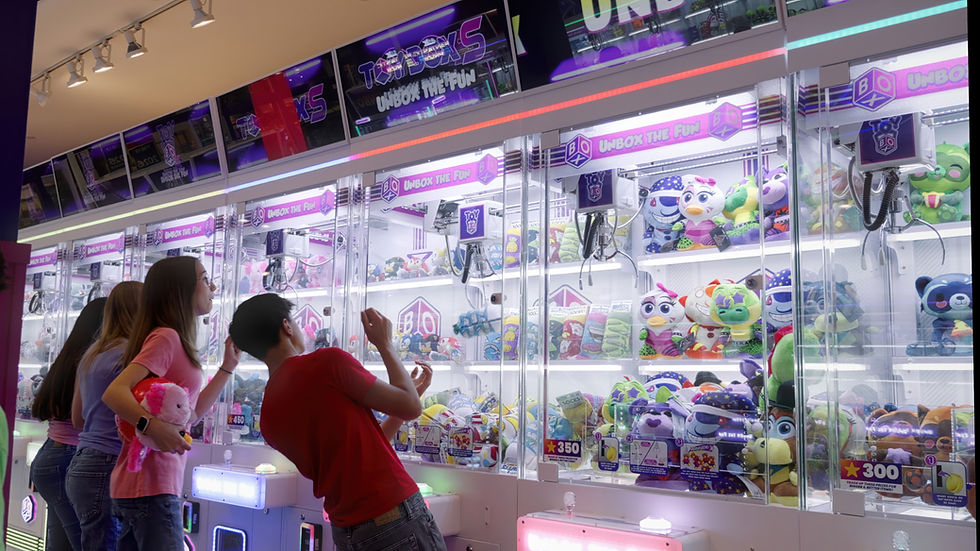
If you walk the midway of almost any Family Entertainment Center and ask the General Manager how their cranes are priced, you’ll often get the same answer: "It's a dollar a play."
But if you ask them why it's a dollar a play, things usually get quiet.
When it comes to merchandisers, claw machines, and pushers, the "set it and forget it" mentality is the fastest way to bleed out your profit margins or entirely kill a guest's desire to play. Operating a profitable merch game isn't about guessing; it is a strict mathematical formula balanced with guest psychology.
Here is how you need to approach pricing and payouts to maximize revenue without blowing your Cost of Goods Sold (COGS).
Understanding Your True "Landed" Cost

You cannot price a game until you know exactly what is going inside it. The days of throwing generic, mixed-bag plush into a crane and charging a dollar are over.
More importantly, the price on the invoice is not your actual cost. You absolutely must factor in shipping and freight to find the true "landed cost." As a general rule of thumb, freight is usually around 10% (or less) of the total plush cost. If you ignore this, you are secretly subsidizing every win out of your own profit margin.
To find your price per play and your win ratio, you need to determine your target COGS based on that landed cost. For most standard cranes, a healthy COGS is between 25% and 30%.
The Formula
Let’s say you are loading a crane with premium licensed plush. The invoice says $5.00 per item. Add 10% for freight ($0.50), bringing your true landed cost to $5.50. If you want to run a strict 25% COGS:
Target Revenue Per Win: $5.50 / 0.25 = $22.00
This means the machine needs to take in $22 for every one prize it pays out.
Pricing Strategies: Price Per Play vs. Win Ratio
Now that you know you need $22 per win, you have to decide how you want the game to play. This is where operator strategy comes in.
Option A (High Volume, Low Cost): You charge $1.00 per play. The machine needs to pay out 1 winner for every 22 plays (a 1-in-22 win ratio).
Option B (Premium Feel, Better Odds): You charge $2.00 per play. The machine pays out 1 winner for every 11 plays (a 1-in-11 win ratio).
Option C (The High-Roller): You charge $3.00 per play. The machine pays out 1 winner for every 7 to 8 plays.
At Planet Novak, we’ve seen firsthand that players will gladly pay $2, $3, or even $5 for a single drop if they feel the claw is strong and the prize is high quality. Option B or C creates a much better guest experience because people are winning much more frequently. That creates crucial crowd-gathering energy, while your profit margin remains exactly the same.

Overcoming Price Anxiety: Stop Fearing the $3+ Swipe
The biggest hurdle operators face is their own fear of raising prices. They worry that a $3 swipe on a claw machine will scare guests away.
The reality is that guests don't evaluate the price of the swipe; they evaluate the perceived value of the prize. A guest will not swipe $1 for a cheap, faded knick-knack. But if you put a giant, trending squish-style plush or high-end electronics in a brightly lit, perfectly clean machine? They will happily swipe $3 or $5 for a chance to win it.
How to Audit Your Own Payouts
Not every facility has their card system perfectly integrated to report wins straight from the claw machines. If you don't have automated tracking set up, there is a very simple way to audit your floor at the end of the month.
Take all the money you spent on plush for the month, and divide it by all the revenue earned by your claw machines that month.
(Total Monthly Plush Spend) ÷ (Total Monthly Crane Revenue) = Your Actual COGS Percentage.
If your target is 25%, but your math comes out to 40%, your games are playing far too easy and costing you money. If it comes out to 12%, your games are playing way too hard, and your guests are leaving frustrated.
Getting the Midway Right
Stop guessing your payouts. Do the math on your true landed costs, calculate your target COGS, and don't be afraid to raise the price per play to give your guests better odds and a premium experience.
If this is an area where your facility is struggling, I would be happy to help. Let’s sit down and look over your game play reports. We can find out if you are charging the right amount, if you are paying out at the right percentage, and most importantly, if you have the right product inside the cranes to drive revenue.

Contact Novak Amusement Solutions today to get your midway optimized.
Conclusion: Your Path to Success
In conclusion, understanding your true landed costs and implementing the right pricing strategies can significantly enhance your Family Entertainment Center's profitability. By focusing on the perceived value of prizes and adjusting your pricing accordingly, you can create a more engaging experience for your guests.
Remember, it's not just about making a sale; it's about creating an experience that keeps guests coming back for more. Whether you choose a high-volume approach or a premium feel, the key is to stay informed and adaptable.
With the right strategies in place, you can transform your claw machines from simple games into powerful revenue generators. Don't hesitate to reach out for assistance in optimizing your operations. Together, we can ensure your Family Entertainment Center thrives in a competitive market.
Comments